



In many countries at many times, the human propensity to control and/or kill those who oppose the power structure has waxed and waned in its bloodthirsty intensity. Fascist and totalitarian urges appear to exist within most societies, held at bay when the belief in the rule of law and the agency of ordinary citizens are the prime directives. When a corrupt, populist leader—of which there have been legions throughout history—decides it’s all about them, everybody suffers, especially the idealists.
In Two Prosecutors, from Ukrainian director Sergey Loznitsa (Mr. Landsbergis), the year is 1937 and the place the Union of Soviet Socialist Republics (USSR), aka the Soviet Union. It’s the height of dictator Josef Stalin’s pre-World War II reign of terror (there would be more, including the war itself, with its millions of cannon-fodder sacrifices). In Bryansk, a town approximately 400 kilometers to the southwest of Moscow, the local branch of the NKVD (the secret police, precursor to the KGB), has ruthlessly arrested scores of ostensible counterrevolutionaries, beating and torturing them until they confess their crimes. In an opening scene, we see how a desperate letter from one of these prisoners, written in blood, is smuggled out.


That missive somehow lands in the hands of Alexander Mikhailovich Kornyev (Alexander Kuznetsov, Here’s to You and Us!), a young prosecutor just recently out of law school. Filled with naïve ideas about communist principles and Soviet law, Kornyev is determined to find out why the man who wrote the letter—an old Bolshevik and former party leader—is incarcerated. That investigation will take Kornyev all the way to the capital and back, and change his life completely (and not for the better).
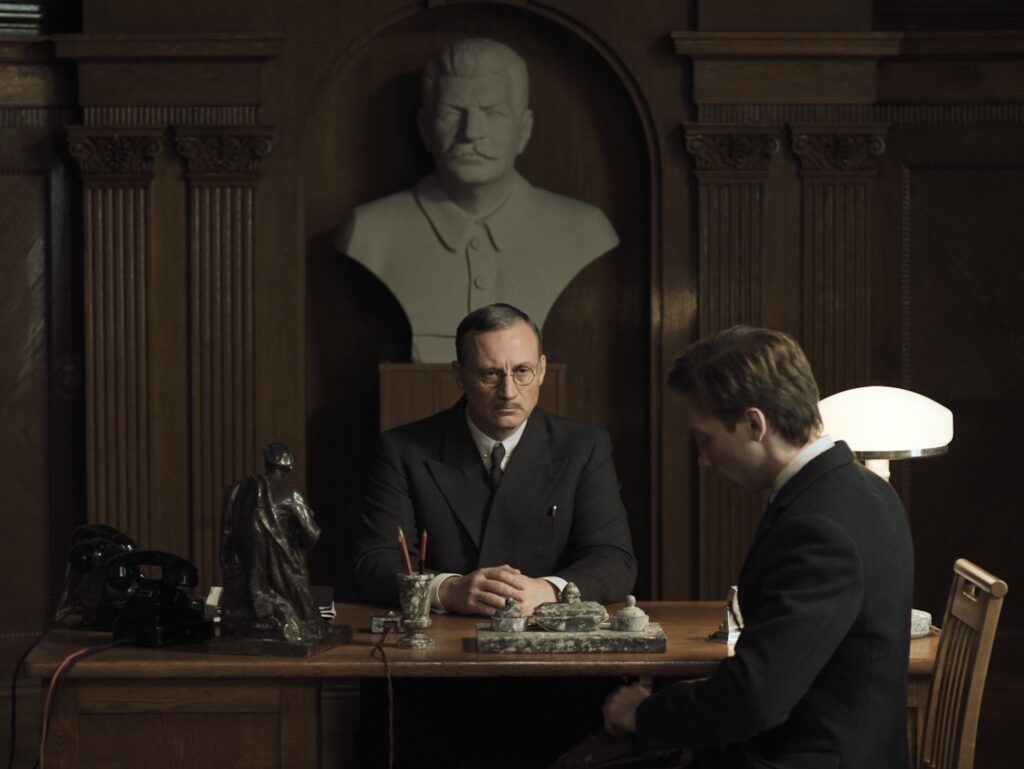
The film is meticulously photographed by Oleg Mutu (Panopticon), the 4:3 Academy ratio filled with frames that further the themes of the film through their evocative, deceptively simple compositions. In a variety of drab earth tones and dingy blues, the images plunge us into a world where the sun only shines on those at the top. Oppose them and, like Icarus, you will fall down hard.


With his squashed boxer’s nose, Kuznetsov looks simultaneously tough and like the innocent he plays, completely out of his depth despite his position of nominal authority. He’s also shorter than almost everyone he meets, further emphasizing the precarity in which his actions place him. The second prosecutor of the title is the main one in Moscow, who appears sympathetic but ultimately is but a tool of the system.
Firmly rooted in the specificity of the situation, Two Prosecutors tells a universal story that is as relevant today as in 1937. Fascist oppression hurts everyone, and true believers are not immune from its damage. Just look at what happens in the United States of the last few years every time a former Trump acolyte questions the truth from on high. It would take but a nudge or two for where we are to shift into what once was. Putin’s Russia has shifted back to Stalinist purges. Will we follow suit?



Christopher Llewellyn Reed


Chris Reed is the editor of Film Festival Today. A member of both the Online Film Critics Society (OFCS) and the Washington DC Area Film Critics Association (WAFCA), and a Rotten Tomatoes-approved film critic, Chris is, in addition, lead film critic at Hammer to Nail and the author of Film Editing: Theory and Practice.