


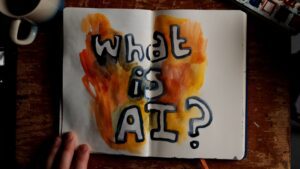
The AI Doc: Or How I Became an Apocaloptimist (Daniel Roher/Charlie Tyrell, 2026) 3½ out of 5 stars
Although there is a high likelihood that artificial intelligence (or AI) will lead to the end of humanity (or at least the human race as we know it)—whether by the systems developing consciousness and eradicating us, the algorithms making such quick decisions that cataclysmic events occur too quickly to stop, or the less dramatic slow-drip of eliminating our capacity for critical thinking—this has not stopped our tech overlords from leaning into the looming apocalypse. Nay, that’s not enough: they will have caused it. But we had a good run as the planet’s dominant species. It’s fitting that by playing God we cause our own extinction.
Doom and gloom are most definitely not the primary thrust of directors Daniel Roher and Charlie Tyrell’s new documentary The AI Doc: Or How I Became an Apocaloptimist, though they certainly address the possibility that the end is nigh. Our guide through this extremely playful and entertaining (we laugh, we cry, we scream!) film is the thirtysomething Roher (Navalny), a recently married artist and computer lover who is soon to be a dad and wants to know whether procreation is the best idea at this particular moment in time. He and Tyrell (making his own feature debut) walk us through complex ideas in as clear a way as possible, throwing in copious animations (many of them stop-motion) to break up the B-roll and talking-head interviews. Roher’s wife Caroline narrates much of the film, adding a simultaneously skeptical and hopeful note to the proceedings

Speaking of interview subjects, there are a lot of experts and technologists on screen here, and it can be hard to keep track of who is saying what. They are the usual suspects of this topic, among them Emily Bender (Department of Linguistics, University of Washington), Liv Boeree (Game Theory Expert + Host, Win-Win Podcast), AI risk advisor Ajeya Cotra, Peter Diamandis (Founder & Chair, XPRIZE and Singularity University), AI reporter Karen Hao, Tristan Harris (Co-Founder, Center for Humane Technology), historian and author Yuval Noah Harari, Jason Matheny (President and CEO, RAND)—who coins the term “apocaloptimist”—Aza Raskin (Co-Founder, Center for Humane Technology & Earth Species Project), and so many more. Impressively, four of the leading United States-based AI creators are also in the movie: Sam Altman (CEO, OpenAI), siblings Daniela and Dario Amodei (Co-Founders and respectively President and CEO, Anthropic), and Demis Hassabis (CEO & Co-Founder, Google DeepMind). Mark Zuckerberg, of Meta, declined to participate, and xAI’s Elon Musk said that something else came up. Sure, bud.
Despite the sometimes-overwhelming plethora of voices, Roher and Tyrell nevertheless manage to explain (mostly) the nature of AI and what the risks and opportunities for the future entail. We start with the former, pivot to the latter, and eventually land somewhere in between, with a dose of “let’s hope for the best!” tacked on at the end (I mean, what else are we supposed to do, short of prayer?). I very much appreciate the call to action from folks like Harris and Raskin, who point out that we are not (yet) helpless in the face of the seeming juggernaut of robots destroying our universe.

One thing I wish the filmmakers had done more of was to ask people like Altman, the Amodeis, and Hassabis the big “why.” Why did we even need any of this technology? Did they not watch the same sci-fi films or read the same novels the rest of us did? Or did they do so and say, “Yeah, I want some of what Cyberdine has to offer”? (Cyberdine is the company in the Terminator franchise.) Personally, I’d love it if the inventors of our demise were all gathered in a shipping container and dropped into the sea, preferably a deep trench. At least we get this documentary out of it, which allows us to laugh our way towards the inevitable inferno. I may be the furthest thing from an “apocaloptimist,” but I appreciate Roher and Tyrell’s efforts.


Christopher Llewellyn Reed


Chris Reed is the editor of Film Festival Today. A member of both the Online Film Critics Society (OFCS) and the Washington DC Area Film Critics Association (WAFCA), and a Rotten Tomatoes-approved film critic, Chris is, in addition, lead film critic at Hammer to Nail and the author of Film Editing: Theory and Practice.