
“De Gaulle: Résistance” Is Best off the Battlefield
Written by: Christopher Llewellyn Reed | November 5th, 2026
 De Gaulle: Résistance (Antonin Baudry, 2026) 3 out of 5 stars
I am half-French, born to an American father and French mother, and spent my childhood in the company of my maternal grandparents, who took me with them on summer vacations through the Hexagon while telling tales of their country’s past. They venerated Charles de Gaulle, leader of the Free French during World War II and then head of the post-war Provisional Government and, later, President of the 5th Republic (indeed, the avatar of such). Most people worldwide know de Gaulle because of the airport in the Parisian suburb of Roissy that bears his name. Love him, hate him, or somewhere in between, he was the central figure of mid-20thcentury France.
And now he gets his very own hagiography, courtesy of director Antonin Baudry (The Wolf’s Call), in two parts, the first of which is now out, the second part to come in December. De Gaulle: Résistance (en français “La Bataille de Gaulle: L’âge de fer”) start with defeat, French forces capitulating to the Nazis. But not everyone. Just as with the comic character Astérix (who would make his debut in 1959, no doubt inspired by the real thing), one man refuses to give up: Charles de Gaulle.

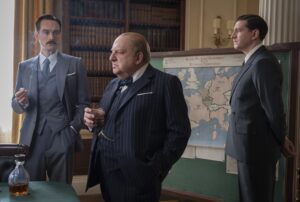
Played by Simon Abkarian (The Audition), de Gaulle is a bear of a man whose confidence combines with his arrogance in equal measure. That’s just the kind of personality needed here, however, given that the British, on whose shores he lands post-retreat, are not sure what to do with him. Prime Minister Winston Churchill (Simon Russell Beale, The Choral) is (sort of) a supporter, but the rest of the English cabinet is leaning towards German appeasement.
The highlight of the movie is the relationship between these two and their witty repartee, Baudry and co-screenwriter Bérénice Vila’s skill with dialogue on vivid display. Abkarian is often quite funny in the lead, though he also has to spend much time staring mournfully out the window while battles rage overseas. Those are not the film’s strongest moments, digital effects of tanks and explosions looking almost AI-generated (whether or not they are is less important than the fact that they appear that way). But every time we are in the room with Abkarian and Beale—or even just Abkarian or just Beale—the narrative soars. They are terrific in their parts.

Beyond the CG skirmishes, the subplot of young French resistance fighter Fernand Bonnier de La Chapelle (Florian Lesieur, Cassandre) on a journey towards his ultimate destiny also proves less-than-compelling. The repetitive, ostensibly stirring musical themes in these sections, meant to evoke patriotic fervor, lean too close to chauvinistic excess and have the opposite effect of what is intended. Still, the overall history lesson, Francophile bias notwithstanding, has its merits, reminding us of the essential perfidy of Marshal Philippe Pétain’s collaborationist Vichy government.
In short, it’s an imperfect homage to de Gaulle, but a frequently fun one. I could watch a chamber piece starring Abkarian and Beale for hours (De Gaulle: Résistance clocks in at 158 minutes). I’m in for Part 2, but could we kill some of the soundtrack? Merci bien!

Christopher Llewellyn Reed

Chris Reed is the editor of Film Festival Today. A member of both the Online Film Critics Society (OFCS) and the Washington DC Area Film Critics Association (WAFCA), and a Rotten Tomatoes-approved film critic, Chris is, in addition, lead film critic at Hammer to Nail and the author of Film Editing: Theory and Practice.